- Winning With Words
- Posts
- What the Stock Market Can Teach You About Mindset and Progress
What the Stock Market Can Teach You About Mindset and Progress
If you’re tempted to define yourself by one bad week, one bad month, or one bad season, you’ll want to read this.

Zach Brandon
November 23, 2025

Today’s Theme: The Frustrating Gap Between Work and Payoff
Have you ever felt like you were genuinely getting better at something, but your results still lagged behind?
I’ve seen this play out over and over with Major League Baseball players. Halfway through a season, their statistics might not look great on paper. But if you pull them aside and ask, “Are you a better player today than you were on Opening Day?” most of them will say yes without hesitation. Their position hasn’t caught up to their trajectory yet.
Today, I want to use a simple image from the stock market, a conversation with a Major League pitcher, and a mental exercise to help you step back from where you are right now and look more clearly at where you’re headed.
What the S&P 500 Really Shows Us About Progress
The image below depicts the growth of the S&P 500 over the past 75 years.
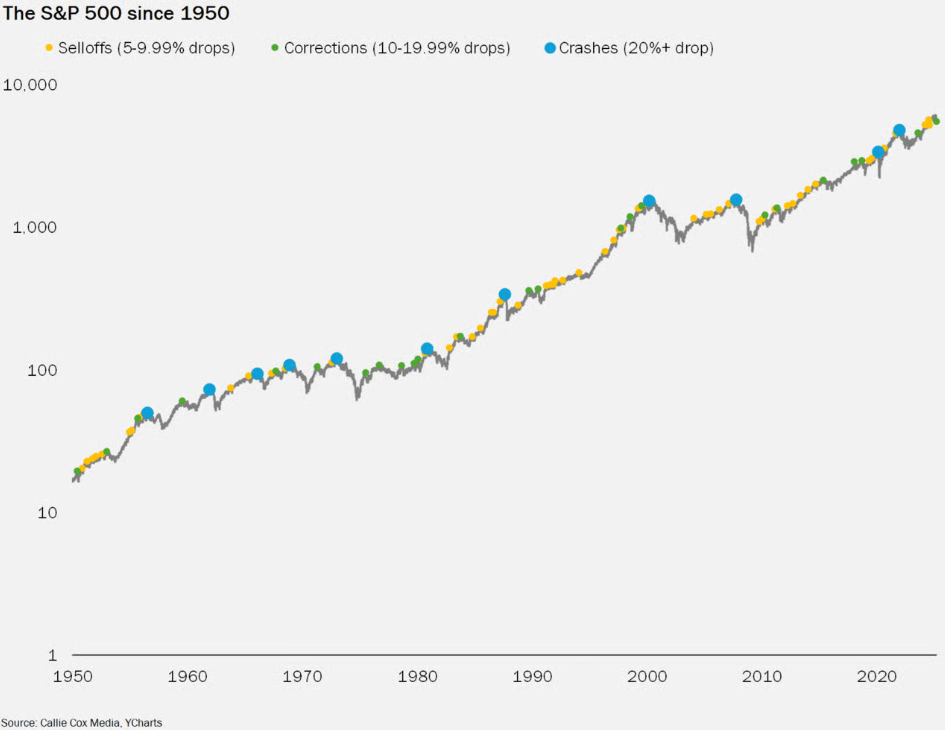
At a zoomed-out perspective, you’ll notice a clear pattern: It has steadily climbed in an upward trajectory over that span. The long-term line trends up and to the right.
But if we zoomed in, the portrait would look very different. At a close-up level, it resembles more of a rollercoaster with sharp climbs, sudden drops, and plenty of bumps along the way. Those drops are what investors call “corrections.”
If you’re an investor and you obsess over, “Where is the market today?” then buckle up. You’ll end up riding an emotional rollercoaster every time the line ticks down.
I like this image because it also reflects the different seasons we encounter in life whether in sport, work, relationships, or any other craft we pursue. Day to day, it’s easy to ride the rollercoaster of what just happened and let yesterday’s performance dictate how we feel about ourselves.
But sometimes we need to stop and zoom out. We need to remember that our current position might not capture the full story of our progress.
Atomic Habits author, James Clear, has talked about this distinction often.
“You should be far more concerned with your current trajectory than with your current results.”
Your position is what you can see right now. Your trajectory is the path your habits and decisions are putting you on.
How Elite Athletes Think When the Numbers Aren’t Pretty
A couple of years ago, I was “shooting the shit” during batting practice with a Major League pitcher and our conversation migrated toward the stock market. He’d recently gotten interested in investing and I was asking questions to learn what he was learning (which I later learned was terrible advice!).
Now, on the surface, this looked like just another pre-game conversation, but I also knew he’d been growing frustrated with his recent performances on the mound. He was coming off a string of three poor outings (his position) and his ERA was starting to climb, but he was confused in that there were underlying factors (e.g. his command, his velocity, his cleaned-up mechanics) he was pleased with (his trajectory).
Internally, his trajectory was improving. Externally, his position said otherwise.
As we wrapped up our conversation about the market, I told him, “Right now, you’re judging yourself off the daily chart. One bad outing feels like a market crash. But if we zoom out over the last month, your ‘trend line’ is climbing. Your position doesn’t tell the full story. Your trajectory does.”
I’ve had this similar conversation with several other players over the last few years and part of my message has been distinguishing two different, but key questions.
“Where am I?” (your position) vs. “Where am I headed?” (your trajectory)
For some, this has become a freeing self-audit because it helps you start to realize that your current position is real, but it’s not permanent.
Klay Thompson captured this beautifully after a brutal shooting night back in April, which he followed with a bounce-back performance against the Mavericks. Reflecting on that earlier game, he said:
That’s the difference between judging yourself by a snapshot and judging yourself by an entire body of work.
Mental PFP’s: How to Zoom Out on Your Own Performance
We hear the following expressions all the time (I’ve used these countless times myself):
“Be here now.”
“Be present.”
“Be where your feet are.”
“This moment. This rep. This pitch.”
All of these contain value. Peak performances live in the present moment.
But your mind’s ability to step back (aka zoom out) and time travel is also a strength when you use it intentionally. In this case, it helps you see your trajectory more clearly.
Years ago, I developed a simple reflective exercise we later called a “Mental PFP” (a nod to baseball, but it represented a Mental Past/Future/Present reflection). It’s a meditative way to zoom out and reassess where you are and where you’re really headed.
Often, I’ll invite players to go back 10 years and forward 20 years into the future. But for today, you can keep the time window smaller and tie it to your current stretch of life or season.
Here’s a version you can try:
1. Visit Your Past Self (2–3 minutes)
Mentally, go back a month or two (e.g. maybe to the beginning of this season) and ask yourself questions such as the following:
How have I grown since then?
What have I learned?
What skills or tools have I added?
What unhelpful habits or ways of thinking have I started to let go of?
Take a moment to acknowledge your growth beyond the stat sheet. Even if your results haven’t caught up yet, your trajectory may already be different.
2. Visit Your Future Self (2–3 minutes)
Now zoom forward to the end of this season and picture yourself looking back on this exact stretch. Ask yourself:
Am I satisfied with the habits and effort I’m bringing right now?
If I keep going like this, do I trust this process to produce better results over time?
What do I want to remember from this recent stretch?
What lesson or perspective do I want my future self to carry forward from what I’m learning now?
This is a chance to do some honest “future forecasting” and to check whether your current habits and mindset match the story you want to tell later.
3. Re-Enter the Present (1 minute)
Finish with a simple question: “What’s one adjustment I want to make today that better reflects the trajectory I want to be on?”
It might be tightening one habit, letting go of one mental pattern, or simply choosing a more accurate story about where you are.
Final Thoughts
There will always be stretches where your results lag behind your growth.
In those moments, it’s easy to define yourself by your position (e.g. today’s numbers, this week’s outcome, that one performance). But you don’t have to.
Your position is where you are right now. Your trajectory is where you’re going and who you’re becoming.
You may not love your current position, but you can keep shaping your trajectory. And over time, like that long-term chart of the S&P 500, a lot of small, consistent decisions can add up to a very different picture than what you see today.
Inspiration for This Piece
The Threshold Lab:
Here’s a quick rundown of last week’s episodes on The Threshold Lab Podcast.
Interview with Kibwe Johnson, Univ. of Maryland and USATF Throws Coach (77 min)
Own Your 3-Foot World: A Strategy to Focus Under Pressure (8 min)
Inside a Mental Courtroom: How to Challenge Limiting Beliefs (8 min)
Muhammad Ali’s Stolen Bike: How Adversity Can Shape Your Drive (7 min)
A New Chapter (9 min)
You can listen to all past episodes here: The Threshold Lab Podcast.
With gratitude,
ZB